Micro Habits: Small Changes, Massive Results
Discover how two-minute habits can eliminate daily friction points and transform your productivity without requiring massive lifestyle changes. These micro habits might seem insignificant at first glance, but their compound effect can revolutionize how you work and live.
5/9/20254 min read
Key Takeaways:
Micro habits take just 2-5 minutes but can dramatically improve productivity and wellbeing
Identifying friction points in your daily routine is the first step to developing effective micro habits
Successful implementation requires integration into existing routines rather than adding completely new processes
The impact of micro habits compounds over time, creating significant positive change
What Are Micro Habits?
Micro habits are tiny, intentional actions that require minimal effort but yield substantial results. Unlike major lifestyle changes that demand significant willpower, micro habits typically take only two to five minutes to execute. Their power lies not in their complexity but in their ability to eliminate friction points that drain your time and energy throughout the day.
For example, placing your phone in another room before studying may seem trivial, but it eliminates the constant distraction of notifications that repeatedly interrupt your focus. Similarly, preparing your study environment with water, charging your laptop, and visiting the bathroom beforehand prevents unnecessary interruptions during your work session.
The beauty of micro habits is that they don't require radical change. Instead, they optimize your existing routines by removing small obstacles that, when accumulated, create significant inefficiency.
How to Identify Your Personal Friction Points
The first step to developing effective micro habits is identifying where your day consistently experiences friction. This requires honest self-reflection and analysis of your routine:
Track your patterns: Monitor your activities for 3-7 days, noting where you consistently feel frustrated, rushed, or unproductive.
Ask targeted questions: When you identify a problem area, ask "why" multiple times to get to the root cause.
Example: "Why am I always late to work?"
Because I leave home too late
Why? Because I get up too late
Why? Because I snooze my alarm multiple times
Solution: Place alarm across the room to force physical movement
Measure the impact: Consider how much time, energy, or peace of mind you lose to these friction points each day and week.
One particularly effective approach is to review your day every few hours and ask: "What went wrong? What caused unnecessary stress or wasted time? Could a simple habit have prevented this?"
Micro Habits That Transformed My Productivity
Morning Optimization
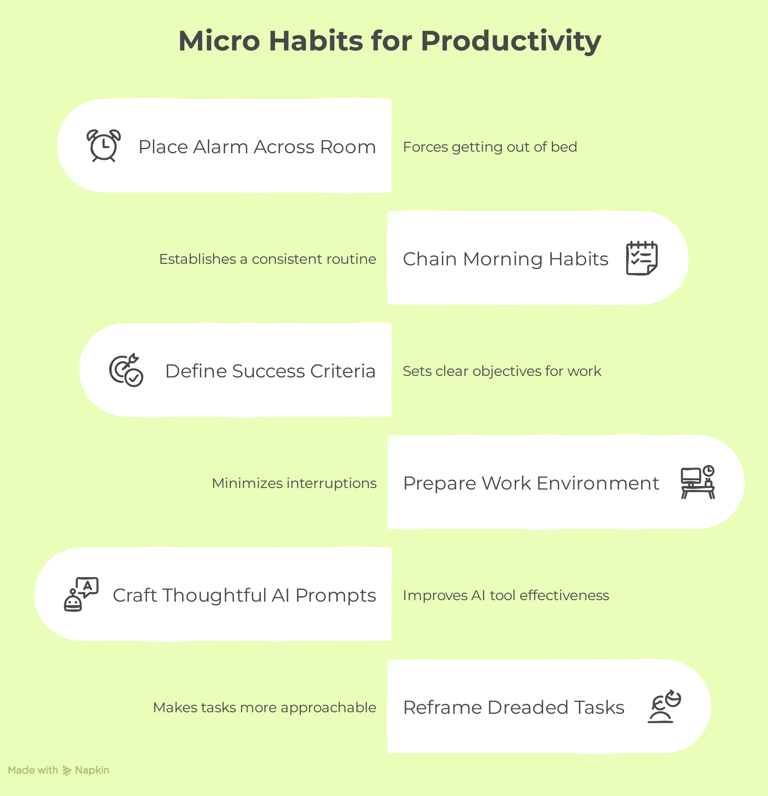
One of my most impactful micro habits involved placing my alarm
clock across the room. This simple change forced me to physically
get out of bed to turn it off, eliminating the snooze cycle that
previously consumed 20 minutes of my morning.
I then chained this with other micro habits: making my bed immediately,
drinking water, brushing teeth, and getting dressed with clothes
I'd laid out the night before. This sequence saved me so much time and stress
that I could actually sleep 15 minutes longer while still arriving at
my 8AM lectures on time and feeling composed rather than rushed.
Work Session Preparation
Before starting any focused work, I now spend 2-3 minutes defining success criteria.
Instead of vague goals like "study math," I write specific objectives:
"Complete exercises 1.2 and 1.3 on sheet 4, noting any questions for review."
This micro habit provides clarity, direction, and the satisfaction of knowing
exactly when I've completed my goals.
I also prepare my environment by:
Charging my laptop
Placing water nearby
Using the bathroom
Turning off my phone or placing it in another room
These small preparations eliminate the most common interruptions during focus time.
AI Tool Optimization
Another micro habit that significantly improved my productivity involves taking 2-3 minutes to craft thoughtful prompts before using AI tools like ChatGPT or Claude. Previously, I would input vague requests, receive unsatisfactory responses, and iterate multiple times—a frustrating and time-consuming process. Now, I briefly consider what output I want, what sources should be consulted, and how the response should be structured. For complex queries, I even ask the AI to help me create an optimal prompt first. This minor preparation dramatically improves the quality of AI assistance and reduces the time spent refining requests.
Task Reframing
I love this concept since I heard about it in Ali Abdaal’s book “Feel Good Productivity” and Greg McKeown's book “Effortless”. Whenever I face a dreaded task, I now implement a two-minute micro habit of asking myself: "What if this task were easy?" or "What if this could be enjoyable or fun?" This brief mental reframing often reveals simple modifications that make tasks more approachable - like working outside on a nice day, adding background music, or collaborating with a friend.
Common Mistakes When Implementing Micro Habits
While micro habits are relatively easy to adopt, people often make several mistakes that prevent successful implementation:
Misidentifying root causes: People frequently address symptoms rather than underlying problems. For example, someone might think they're late to work because they snooze too long, when actually they spend too much time deciding what to wear or gathering scattered items.
Attempting too many changes at once: Enthusiasm often leads to implementing numerous habits simultaneously, which can become overwhelming. Focus on one or two micro habits at a time until they become automatic before adding more.
Failing to integrate into existing routines: Standalone habits are easily forgotten. The most successful micro habits either replace existing behaviors or attach to already established routines.
Underestimating impact: Many people dismiss micro habits as insignificant, not recognizing how small friction points compound over time. A five-minute daily inefficiency equals more than 30 hours annually—nearly a full workweek lost to a problem that could be solved with a two-minute habit.
Final Thoughts
Micro habits represent the perfect intersection of minimal effort and maximum impact. By identifying friction points in your daily routine and implementing targeted two-minute solutions, you can dramatically improve your productivity and wellbeing without feeling overwhelmed by change.
What small friction point in your daily routine could you eliminate with a micro habit? Start with just one area this week, and you might be surprised by how such a tiny change can transform your experience.
[Check out my previous post on how to build mental and physical strength.]